If you have ever struggled with deep, persistent depression, you know the drill. You schedule the therapy sessions, you wait weeks for your prescription to kick in, and you deal with the annoying side effects. Then, nothing happens.
For millions of people, traditional antidepressants like SSRIs simply do not work. In fact, about 30% of people diagnosed with major depressive disorder do not find relief after trying two or more standard medication trials.¹ This is what doctors call treatment-resistant depression.
Living with this condition is exhausting. It is easy to feel like you are out of options, or worse, that you are somehow failing at getting better. Have you been there?
Fortunately, the field of psychiatry is undergoing a massive shift. We are moving away from the old trial-and-error approach of daily pills. Today, clinical breakthroughs are offering rapid, highly targeted options that actually change how the brain functions.
Ketamine Therapy and Rewiring the Brain
For years, the medical community looked at depression through a narrow lens, focusing almost entirely on serotonin and norepinephrine. Ketamine changed everything by targeting glutamate, the most common chemical messenger in your brain.
Instead of slowly building up neurotransmitter levels over months, ketamine triggers a rapid growth of new neural connections. Think of it like clearing a blocked highway so traffic can flow freely again.
This approach works incredibly fast. Although standard antidepressants can take a month or more to show results, ketamine can lift suicidal thoughts and heavy depressive symptoms within hours.
Clinically, you will find this treatment in two main forms. There is intravenous (IV) racemic ketamine, which is used off-label, and intranasal esketamine, marketed under the brand name Spravato, which is FDA-approved.
A major study from McLean Hospital and Harvard University compared these two methods head-to-head.² Researchers tracked 153 adults with severe treatment-resistant depression during a month-long treatment phase.²
The results were eye-opening. Both treatments helped, but IV ketamine was faster and more effective.
Patients receiving IV infusions experienced a 49.2% reduction in depressive symptoms by their final session, compared to a 39.6% reduction for the nasal spray group.² Even more striking, the IV patients showed significant relief after their very first dose, while the nasal spray group required two doses before showing a clear response.²
But there is a catch, and it comes down to cost. Patented esketamine nasal sprays can cost up to $900 per dose out of pocket if your insurance does not cover it.
On the other hand, generic ketamine is incredibly cheap, costing as little as $5 to $20 per dose.³ The problem is that because it is used off-label, insurance rarely covers the infusion clinic fees.
The good news is that generic ketamine is proving its worth in long-term safety studies. Research published in late 2025 confirmed that low-cost generic ketamine is safe, effective, and well-tolerated for up to six months of continuous, monitored use.³
Because of its powerful, mind-altering effects, you cannot just take this drug at home. You must receive it in a certified clinic where medical staff can monitor your blood pressure and help you handle the brief, dream-like state.
TMS Treatment and Non-Invasive Neuromodulation
What if you want to avoid medication entirely? That is where Transcranial Magnetic Stimulation (TMS) comes in.
TMS is a non-invasive procedure that uses magnetic pulses to stimulate underactive regions of the brain. Specifically, it targets the left dorsolateral prefrontal cortex, which is the area responsible for mood regulation.
Think of TMS like a targeted workout for your brain cells. It coaxes quiet neurons back to life without sending chemicals through your entire bloodstream.
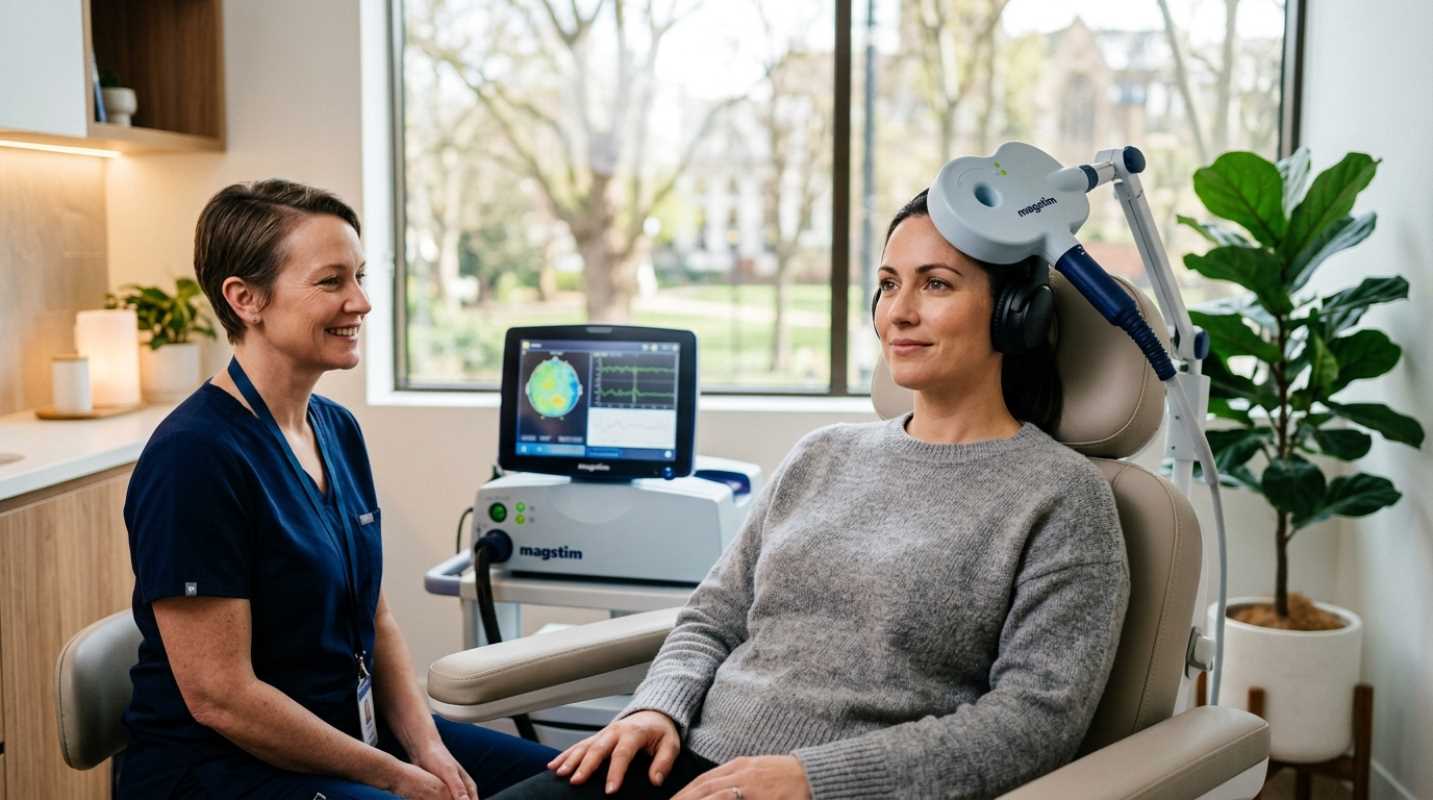
The patient experience is remarkably easy. You sit in a comfortable chair while a magnetic coil is placed gently against your head.
You will hear a rapid tapping sound, but you will not feel any pain. Because there are no systemic side effects, you will not have to deal with weight gain, nausea, or sexual dysfunction. You can easily drive yourself home or go right back to work after a session.
The clinical guidelines for TMS have evolved rapidly. The National Network of Depression Centers updated its consensus guidelines, officially endorsing TMS as a first-line recommendation for treatment-resistant depression.
They highlighted a protocol called Theta Burst Stimulation. This newer approach is just as effective as traditional TMS but cuts session times from 30 minutes down to just over three minutes.
If you want the fastest results possible, look at the SAINT protocol. This method compresses an entire six-week course of TMS into just five consecutive days, using personalized brain scans to target the magnetic pulses with extreme precision.
Clinical trials of the SAINT protocol have shown response rates as high as 85%. In early 2026, researchers expanded this technology to treat postpartum depression, offering new mothers a rapid, drug-free path to recovery when they cannot afford to wait weeks for a pill to work.⁴
The Future Horizon with Psychedelics and Beyond
The next major wave of depression treatment is already arriving, led by psychedelic-assisted therapy.
Compass Pathways recently completed its Phase 3 trials for COMP360, a synthetic version of psilocybin. The data from these trials showed that just one or two doses of psilocybin, paired with professional psychological support, led to a significant drop in depression scores that lasted for up to six months.
This is not about taking a recreational drug. It is about using a powerful biological tool in a highly structured, therapeutic environment to help your brain step out of rigid, negative thinking patterns.
This progress points toward a future of personalized medicine. Psychiatry is finally moving away from the idea that one pill should work for everyone.
The goal now is to look at your specific brain chemistry, your history, and your lifestyle to build a highly customized treatment plan.
If you are ready to explore these modern interventional therapies, here are some of the most reliable paths to start your journey.
Taking Control and Navigating Your Treatment Options
It is easy to feel defeated when standard treatments fail. But you do not have to accept a life lived under a gray cloud.
If you are ready to explore these emerging therapies, here is how you can take action.
• Talk to your doctor. Ask them directly about interventional psychiatry. Do not just settle for another standard SSRI swap if the first two did not work.
• Find a certified clinic. Look for local providers who specialize in IV ketamine infusions or offer advanced TMS options like the SAINT protocol.
• Verify your coverage. Call your insurance provider to ask about coverage for nasal esketamine or TMS. Many major plans now cover these treatments once you have failed a couple of standard medication trials.
Modern psychiatry is no longer about just managing your symptoms. It is about actively healing your brain's physical pathways. If the old tools did not work for you, do not lose hope. The new tools are here, and they are changing lives every day.
Sources:
1. Emerging Therapeutic Approaches to Treatment-Resistant Depression
https://www.ahdbonline.com/supplements/emerging-therapeutic-approaches-to-treatment-resistant-depression-meeting-unmet-clinical-needs
2. First study to compare two ketamine therapies for patients with severe depression
https://news.harvard.edu/gazette/story/2025/09/first-study-to-compare-two-ketamine-therapies-for-patients-with-severe-depression/
3. Prescription Ketamine Therapy for Treatment-Resistant Depression
https://a4pc.org/p3/prescription-ketamine-therapy-for-treatment-resistant-depression
4. TMS Treatment
https://www.musc.edu/content-hub/News/2026/04/14/tms-treatment
*This article on WellnessChecker is for informational and educational purposes only. Readers are encouraged to consult qualified professionals and verify details with official sources before making decisions. This content does not constitute professional advice.*