Have you ever spent an hour meticulously sorting toys, only to watch your kids dismantle your hard work in thirty seconds flat? It is an exhausting cycle. You clean, they scatter, you repeat, and everyone ends up frustrated.
The problem is not your parenting, and it is certainly not your kids. The issue is that most home organization systems are built for adult aesthetics rather than child psychology. We design spaces that look great on social media but require too much cognitive effort for a child to maintain.
So what does this actually mean? It means we need to stop organizing for ourselves and start organizing for our kids. Consider the sheer volume of things we manage. A study by UCLA found that adding a child to a household increases a family's physical possessions by 30% during the preschool years alone.¹ Even more striking, the average 10-year-old owns 238 toys but plays with just 12 daily.² Although US children make up only 3.1% of the global kid population, they consume 40% of the toys purchased worldwide.³
By building systems around how kids actually think and move, we can cut daily housework by up to 40% and help our kids build independence.⁴
The Foundation Editing Before Organizing
Before you buy a single plastic bin, you have to clear the decks. Trying to organize clutter is a losing battle. Instead, make decluttering a collaborative family activity.
Getting kids to part with their things is notoriously tough, but professional organizers use a few gentle approaches to make it painless
• The Maybe Bin: If your child is struggling to let go of a toy they are outgrowing, place it in a designated box and store it out of sight. If they do not ask for it within a set timeframe, you can safely donate it.
• The Treasure Drawer: Give your child one specific drawer or box for their random collections of rocks, plastic trinkets, and artwork. Explain that they can keep whatever they want inside it, but once it is full, they must discard an old item before adding a new one.
• The 10-Toy Quest: Turn decluttering into a game. Ask your child to find ten items they no longer play with to pass along to other kids.
• The 30-Day Challenge: Tackle one tiny area together every day, such as shoes on day one and board games on day two, as recommended by organizer Susie Salinas.⁵
Zone-Based Approach for Kids Room Organization
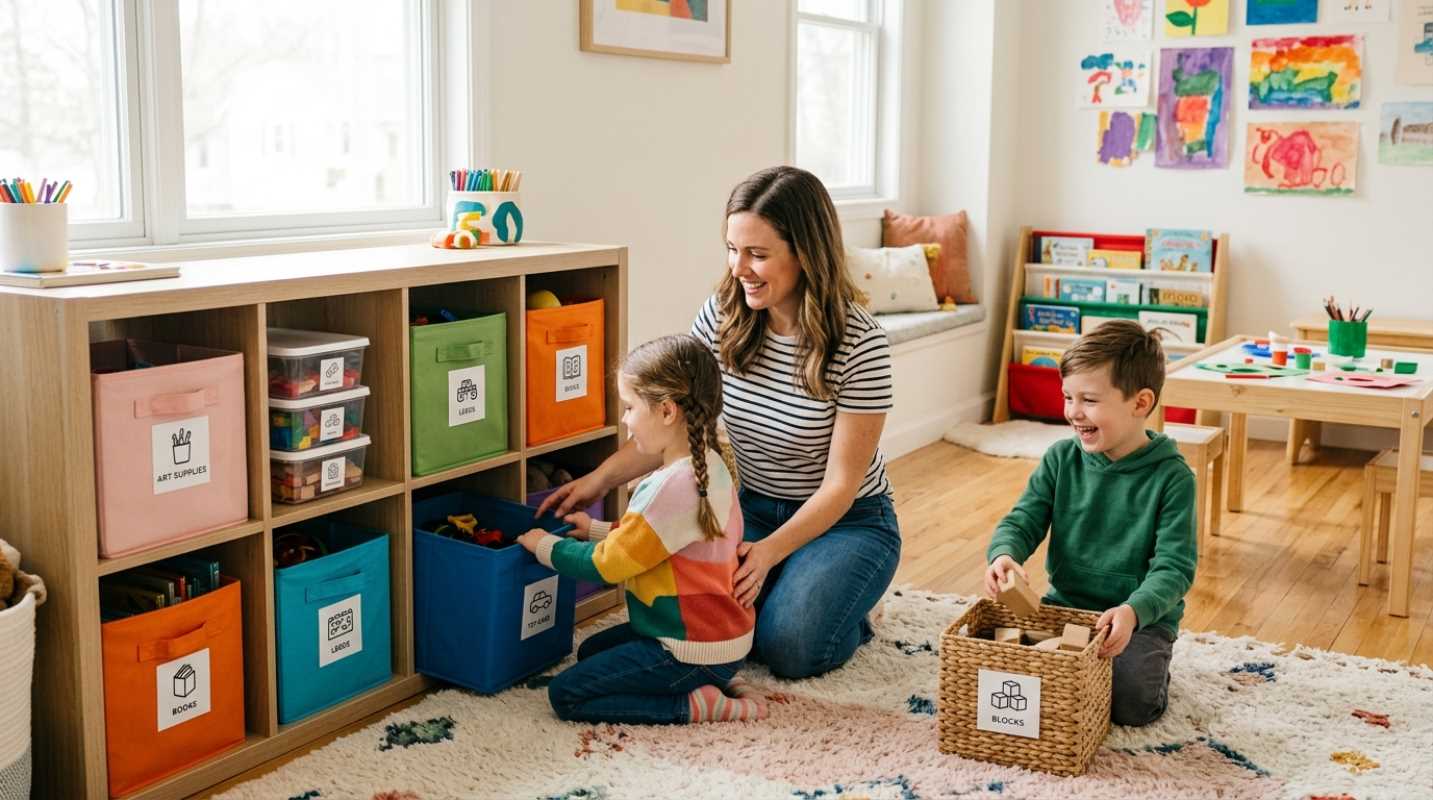
Once you have edited down the belongings, it is time to set up your space. Think of your child's room as a series of distinct activity zones, including a reading zone, a building zone, and an art zone.
The way you store items within these zones determines whether the system succeeds or fails. Fussy, high-maintenance storage systems, like decanting every toy into perfectly matching containers, are out. They simply create too much work.
Instead, keep these design rules in mind
• Ditch the heavy lids: Avoid oversized toy chests and heavy wicker baskets that can pinch fingers or snag clothes.
• Embrace the open bin: Use open-topped, lightweight bins made of durable wood or recycled plastic. If a child can toss a toy into a bin like a basketball, they will do it.
• Organize bottom to top: Keep daily-use items at your child's eye level or lower. If they have to reach high or use a hanger, the item will end up on the floor.
One of the most effective setups is a toy rotation system. Keep only five to ten favorite toys out in the active play area, and store the rest in a closet. Rotate them every couple of weeks. This keeps the toys feeling fresh and prevents the a lot of mess that leads to kids dumping entire bins onto the floor.
Visual Cues and Labeling The Secret to Independence
How do kids know where things go if they cannot read yet? They don't, unless you use visual cues.
For younger children, picture labels are vastly superior to text. You can take photos of their actual toys, such as a pile of blocks or a stack of books, print them out, and tape them to the front of the corresponding bins.
Get your kids involved in this process. Let them draw the labels or choose the color-coding system. When children participate in building the system, they feel a sense of ownership over keeping it clean.
To help you get started on your organizational journey, here are some of the best kid-friendly storage solutions on the market today.
Maintenance Hacks That Actually Stick
No system runs on autopilot. You need simple, low-effort routines to keep the clutter from creeping back.
One of the best habits is the five-minute tidy before bed. Make it a routine, not a chore. Turn on a favorite song and see if the family can put away their active toys before the music stops.
You can also build independence in the kitchen. Create a self-serve cupboard in a bottom cabinet or pantry drawer. Fill it with school lunchboxes, water bottles, and healthy snacks. This allows your kids to pack their own snacks and put away their lunch gear without your help.
For the entryway, install low wall hooks at your child's chest height for backpacks and jackets, paired with open, labeled floor baskets for shoes. This simple drop zone prevents the school-day explosion of paper and gear on the kitchen counter.
The Long Game of Family Organization
At the end of the day, your home is a living space, not a museum. The goal of these systems is not to achieve picture-perfect neatness, but to make daily life run smoother.
Think of organization as an changing skill that your children are learning over time. There will be messy days, and that is completely fine. By keeping systems simple, low, and visual, you are giving your kids the tools they need to take care of their own spaces, building habits that will last a lifetime.
Sources:
1. Organized Interiors
https://www.organizedinteriors.com/blog/home-organization-statistics/
2. Becoming Minimalist
https://www.becomingminimalist.com/clutter-stats/
3. Just Organized
https://justorganized.org/20-eye-opening-statistics-about-clutter-and-over-consumption/
4. Pick Up Please
https://pickupplease.org/7-organization-stats/
5. Organize Well
https://www.organizewell.com/blog/organizing-with-kids/